
The aerospace industry demands perfection at every stage of the manufacturing lifecycle. Whether you are building components for commercial aviation, defense systems, or the booming commercial space sector, the journey from a brilliant engineering concept to a flight-ready component is a high-stakes process. For procurement managers and engineers, one of the greatest supply chain challenges is finding a manufacturing partner capable of seamlessly navigating this transition.
Scaling production requires much more than just turning on more machines. It demands a sophisticated approach that bridges agile aerospace prototyping, rigorous First Article Inspection (FAI), and efficient aerospace production machining. Here is an inside look at how top-tier machine shops successfully scale your projects from a single prototype to high-volume production without sacrificing precision or extending lead times.
Step 1: Agile Aerospace Prototyping and DFM
Every successful flight-ready part begins as a prototype. However, in the aerospace sector, prototyping isn’t just about proving that a part can be made; it’s about proving it can be made consistently, cost-effectively, and to exacting tolerances.
When a trusted Los Angeles aerospace machine shop receives a new CAD model, the first step is a comprehensive Design for Manufacturability (DFM) review. Machinists and manufacturing engineers collaborate with your design team to identify potential bottlenecks. Can a sharp internal corner be given a slight radius to allow for a standard endmill? Is a specific grade of titanium strictly necessary, or would a more machinable aerospace aluminum suffice without compromising structural integrity?
During the prototyping phase, the goal is speed and iteration. By utilizing advanced 5-axis CNC machining, complex geometries can be cut in a single setup. This reduces handling errors and delivers the prototype to your engineering team faster for form, fit, and function testing.
Step 2: The Critical First Article Inspection (FAI)
Once the prototype is validated and the design is locked, the transition to production begins. But in aerospace, you cannot simply press “go” on a 1,000-part run. The bridge between prototyping and production is the First Article Inspection (FAI).
In accordance with AS9102 standards, an FAI is a comprehensive, documented validation that the manufacturing process reliably produces a part that meets all blueprint specifications. It is not just an inspection of the part itself; it is an audit of the entire machining process.
During an FAI, a machine shop will:
- Verify Material Traceability: Ensure all raw materials (like Inconel, Titanium, or 7075 Aluminum) have proper mill certifications and origin tracing.
- Audit the Manufacturing Routing: Lock in the feeds, speeds, and tooling paths to guarantee repeatability.
- Perform Rigorous Metrology: Utilize highly calibrated Coordinate Measuring Machines (CMM) to verify every single dimension, geometric dimensioning and tolerancing (GD&T) callout, and surface finish requirement.
A successful FAI proves to the procurement team that the shop has the precise recipe required to replicate the part flawlessly. Once the FAI report is approved, the process is firmly locked, and scaling can safely commence.
Step 3: Transitioning to Aerospace Production Machining
Moving from FAI to aerospace production machining requires a fundamental shift in strategy. Prototyping prioritizes flexibility, while production prioritizes stability and efficiency. To scale up, an aerospace CNC supplier must optimize the machining process for volume. This involves:
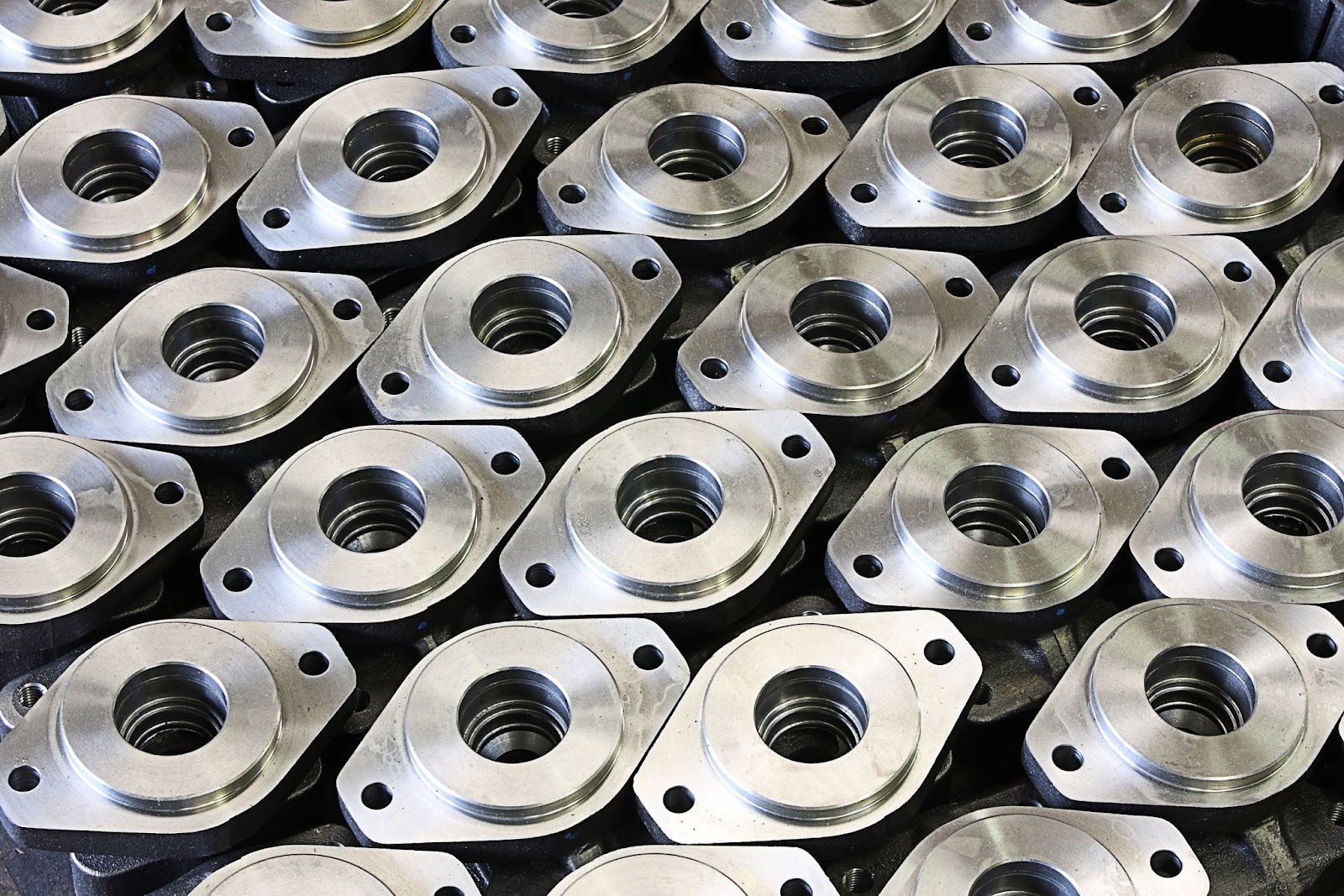
- Custom Fixturing: Designing robust, multi-part workholding fixtures (often called tombstones) that allow the CNC machine to cut multiple parts simultaneously in a single cycle.
- Tool Life Management: High-temp exotic alloys degrade cutting tools quickly. For production runs, shops implement strict tool-life management systems, programming the CNC machines to automatically swap out endmills and drills before they wear down and compromise part tolerances.
- Process Automation: Utilizing automated pallet pools and robotic loaders allows the machines to run lights-out. This maximizes spindle uptime, drastically reducing lead times and lowering the cost-per-part for the buyer.
Step 4: Achieving High-Volume Aerospace CNC Machining
When moving into high-volume aerospace CNC production, maintaining quality control across thousands of units is the ultimate test of a machine shop’s capabilities. The AS9100 quality management system becomes the backbone of the operation.
At this stage, statistical process control (SPC) is implemented. Instead of inspecting every single dimension of every single part (which is inefficient and costly), operators use in-process probing and scheduled CMM inspections to monitor trends. If a dimension begins to drift even a few ten-thousandths of an inch due to thermal expansion or minor tool wear, the machinist can adjust the machine offsets long before a part falls out of tolerance.
Furthermore, high-volume production requires exceptional supply chain management. A capable local partner will manage raw material purchasing, outside processing (like anodizing, heat treating, or passivation), and final assembly, delivering a complete, flight-ready component directly to your receiving dock.
The Value of an End-to-End Manufacturing Partner
Consolidating your supply base is one of the most effective ways to reduce procurement headaches. Transferring a project from a specialized prototyping house to a separate high-volume production facility introduces massive risks: lost tribal knowledge, duplicated tooling costs, and the need for a second, time-consuming FAI.
By partnering with a comprehensively equipped aerospace machine shop capable of handling the entire lifecycle, procurement managers eliminate these risks. From the first conceptual prototype to the final shipment of a high-volume production run, you ensure continuous quality, faster time-to-market, and a streamlined supply chain ready to support the next generation of flight.